Compliant. Fast. Built for the way teens apply.
Turn is a Consumer Reporting Agency subject to the FCRA that supports background screening for applicants ages 15 to 17, with expert guidance on parental consent requirements, a mobile-optimized candidate experience, and FCRA-compliant adverse action tools built in.
More than 5 million teens ages 16 to 19 enter the U.S. workforce each summer, according to the Bureau of Labor Statistics. For retail, food service, and hospitality employers, minors represent a significant share of seasonal and part-time hiring. The background check process for a 16-year-old isn't the same as for an adult. Three things change: who provides consent, what records are reportable, and how your platform needs to handle the workflow.
Minors cannot legally authorize their own background check. Under state law and established best practice, a parent or guardian must provide written authorization before processing can begin. If a minor signs the form without a parent or guardian, the resulting report may not be legally binding.

In most states, records handled in juvenile court are sealed and cannot be reported. What can appear: records from cases tried in adult court, sex offender registry entries, and motor vehicle records. The scope depends on state law.
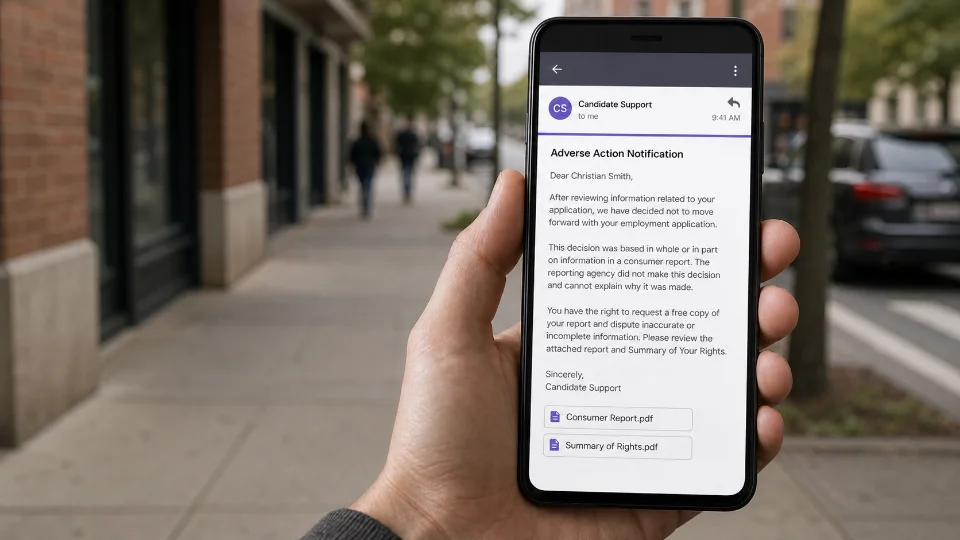
If screening results may affect a hiring decision, the FCRA pre-adverse and adverse action process applies. For minor applicants, notices should be sent to both the applicant and their parent or guardian. Turn's platform handles this workflow automatically.
The FCRA governs all employment background checks in the United States, including those for minor applicants. Its requirements apply in full. The critical difference for minors is consent: because minors lack the legal capacity to enter binding contracts, a parent or legal guardian must sign the FCRA disclosure and authorization form.
The FLSA sets the federal framework for employing minors. Minimum employment age is 14. Workers under 16 face restrictions on hours and job categories. Workers under 18 are prohibited from hazardous occupations. Employers are responsible for confirming the minor's eligibility for the specific role before beginning work.
Reportability varies by state. Some states allow limited juvenile record access for specific employer types. Consult legal counsel for your jurisdiction.
This section is for informational purposes only and does not constitute legal advice. Laws vary by state and change over time. Consult qualified legal counsel for guidance specific to your hiring situation.
Screening a minor applicant requires a few additional steps compared to an adult check. The parental consent obligation belongs to the employer. Here is what your team needs to handle at each stage.
Create the check from your Turn dashboard. Select a package configured for minor applicants and enter the applicant's name, email, date of birth, and the parent or guardian's contact information.
Confirm the applicant is under 18 and meets the minimum employment age for the role and state. Verify whether a state work permit or age certificate is required before the minor can begin work.
Provide the parent or legal guardian with the FCRA disclosure and authorization form before placing the check. Turn provides documentation templates for this step. The parent or guardian must sign and return the form. Retain it in the applicant's file.
Once signed parental or guardian authorization is obtained and retained, place the background check order in the Turn dashboard. Select the minor-appropriate package and confirm the applicant's date of birth.
Turn processes the check according to your configured package. Most checks complete within 6 hours. Results are filtered for reportability under applicable state law.
The completed report appears in the Turn dashboard. Criminal records include ClarifAI plain-English translations. Adjudicate and follow FCRA adverse action procedures if needed, with pre-adverse notices sent to both the applicant and their parent or guardian.
Most standard employment checks are available for minor applicants. The key difference is what can be reported, not what can be ordered. Turn supports all of the following for minor applicants with parental consent.
Searches national criminal databases for records tied to the applicant's identity. For minor applicants, results reflect only records that are legally reportable in your jurisdiction.
Direct courthouse searches in counties where the applicant has lived or worked. Turn's 7-year county criminal search covers every courthouse in a candidate's address history, capturing records that national databases often miss. Provides the most current and accurate record of adult court cases.
Searches national and state sex offender registries. Juveniles ages 14 and older convicted of applicable offenses may appear in state registries depending on the nature of the offense and state law.
Available for minor applicants who hold a driver's license. Confirms license status, violations, and suspensions. Required for any role that involves driving.
SSN trace and address history to confirm the applicant's identity before the check runs. Helps catch misrepresented age or identity before processing begins.
Verifies prior employment history and school enrollment. Useful for teen applicants with previous jobs or school-based credentials. Requires parental consent as part of the overall authorization.
Available for minor applicants with parental consent. State-specific laws on drug testing minors vary significantly. Consult legal counsel before including drug testing in a minor applicant package.
Post-hire monitoring for new criminal activity, available for minor employees once hired. Alerts trigger on new records that meet your configured criteria, backed by a platform built for 99.9% uptime and sub-second API response.
Credit checks are generally not appropriate for minor applicants in entry-level roles and may be unavailable due to limited credit history. Consult legal counsel before including credit checks for minors.
Teen workers are a significant labor pool in these industries. Turn's platform is configured to support minor applicant screening at high volume for each.
Sales associates, cashiers, and stock clerks are among the most common entry-level roles for teens. Retail chains with high-volume seasonal hiring benefit most from Turn's parental consent guidance and documentation, batch upload for bulk hiring events, and multi-location compliance that applies the correct rules based on each candidate's location.
Quick-service restaurants, fast casual, and cafes frequently hire teens as crew members and cashiers. Turn's mobile-first candidate experience and 94% completion rate reduce drop-off for teen candidates.
Resort, hotel, and attraction employers hire large numbers of teen workers during summer and holiday seasons. Turn's 6-hour median turnaround helps seasonal employers hire fast without sacrificing compliance.
Staffing agencies placing minors in retail, food service, and light industrial roles need a screening partner with clear parental consent guidance, compliant screening infrastructure, and documentation resources that apply across every client and order.
Altar'd State, a women's fashion and lifestyle retailer with more than 130 store locations across 39 U.S. states, uses Turn for background screening across its full workforce, including minor applicants hired for seasonal and part-time retail roles. After switching to Turn, Altar'd State achieved a sub-16-second median turnaround time on background checks, a 37.36% increase in candidate conversion rate, and a 40% reduction in screening costs compared to their previous provider. They expanded screening from new hires only to all corporate and store-level employees.
Most screening providers offer little practical guidance on parental consent for minor applicants. Turn provides employers with parental consent documentation templates, state-specific requirement summaries, and compliance resources that surface when a check is initiated for a minor applicant. Employers own the authorization obligation. Turn makes it easier to fulfill it correctly.
Teen applicants complete everything on their phones. Parents and guardians receive mobile-optimized consent requests that are easy to complete without technical friction. Turn's bilingual candidate portal, available in English and Spanish, supports the diverse teen and family populations retail and food service employers hire from. Turn's 94% candidate completion rate reflects a process designed for younger applicants and their families, not just seasoned job seekers.
When a criminal record does appear on a minor applicant's check, it typically involves a case tried in adult court. Those records often use legal shorthand, jurisdiction-specific charge codes, and statutory citations that are difficult for non-attorneys to interpret correctly. ClarifAI translates every criminal record into plain English, with a human review step before delivery. Your team adjudicates consistently without needing to decode legal language.
If a minor applicant's background check may affect a hiring decision, Turn's platform walks your team through the full FCRA pre-adverse and adverse action process. Pre-adverse notices can be sent to both the applicant and their parent or guardian from the report view. The audit trail is maintained automatically.
Juvenile record reportability varies significantly across U.S. states. Some states seal all juvenile records. Others allow limited access for specific employer types or offense categories. Ban-the-Box laws in many states and cities restrict when and how criminal record information can be used in hiring decisions, with some provisions that specifically address juvenile records.
SOC 2 Type II certified
SOC 3 compliant
ISO 27001-aligned workflows
PBSA member
Bilingual candidate and guardian support
Employer compliance obligations vary by state and role. Turn's platform supports FCRA-required workflows but does not substitute for qualified legal counsel.
Yes. Employers can run background checks on minor applicants ages 14 and older, subject to specific legal requirements. The Fair Credit Reporting Act (FCRA) applies to background checks on minors just as it applies to adult applicants. The key differences are that a parent or legal guardian must provide written consent before the check can begin, and the information reportable for minor applicants is more limited than for adult applicants because most juvenile records are sealed by state law. Employers should consult qualified legal counsel for guidance specific to their jurisdiction.
Yes. Minors do not have the legal capacity to consent to a background check on their own. A parent or legal guardian must provide written authorization before a Consumer Reporting Agency can initiate screening on a minor applicant. If the minor signs the consent form without a parent or guardian, the resulting report may not be legally binding and could expose the employer to FCRA liability. The parental consent obligation arises primarily from state contract law and state-specific screening requirements, not from the federal FCRA directly. Turn provides employers with parental consent guidance and documentation templates to help manage this requirement. Employers are responsible for obtaining and retaining valid parental or guardian authorization before initiating a background check on a minor applicant.
What appears on a background check for a minor depends on whether the applicant has any records that are not protected by juvenile record sealing laws. In most U.S. states, juvenile adjudications, cases handled in juvenile court, are sealed and cannot be reported by a Consumer Reporting Agency. Records that can appear include criminal convictions for cases tried in adult court, sex offender registry entries for applicable offenses, motor vehicle records if the minor holds a driver's license, employment and education history, and identity verification results. Employers should be aware that available records vary by state.
In most U.S. states, juvenile records are sealed and cannot be reported by a Consumer Reporting Agency in an employment background check. However, there are exceptions. If a minor was tried as an adult rather than in juvenile court, that record is generally reportable and will appear. Some states allow limited access to juvenile records for specific types of employers. Sex offender registry information may appear for juveniles ages 14 and older convicted of applicable offenses, depending on state law. Employers should not assume juvenile records are entirely inaccessible and should consult legal counsel when in doubt.
Under the Fair Labor Standards Act (FLSA), the minimum age for most non-agricultural employment in the United States is 14 years old. Accordingly, the practical minimum age for employment background checks is also 14. Some Consumer Reporting Agencies, including Turn, set a minimum age of 15 for processing a background check. The FCRA applies to background checks regardless of the applicant's age, and parental consent is required for all applicants under 18.
For retail, food service, and hospitality employers hiring minors, the most commonly used background checks are criminal background checks (national and county), sex offender registry searches, identity verification, and employment verification for any prior work history. Motor vehicle records are relevant for any role that involves driving. Drug testing may be appropriate depending on the role and state law, but requires parental consent for minors. Credit checks are generally not relevant for entry-level teen positions. Employers should configure their packages to match the scope of the role and consult legal counsel for jurisdiction-specific requirements.
The parental consent obligation belongs to the employer, not the CRA. Employers are responsible for obtaining written authorization from the minor applicant's parent or legal guardian before requesting a background check. Turn supports employers in meeting this obligation by providing parental consent documentation templates, guidance on state-specific requirements, and compliance resources available when a check is initiated for a minor applicant. Turn's team surfaces the parental consent requirement when a minor's date of birth is entered, noting the employer's responsibility and providing documentation to support the process. The employer retains responsibility for collecting and retaining signed authorization.
Yes, but the same FCRA adverse action rules that apply to adult applicants also apply to minors. If an employer is considering not hiring a minor applicant based on background check results, the employer must follow the pre-adverse action process: send a pre-adverse action notice to the applicant and their parent or guardian along with a copy of the report and a summary of rights, wait the legally required period for the applicant to respond, then issue the final adverse action notice if the decision stands. Employers should also consider whether any Ban-the-Box laws in their jurisdiction restrict using juvenile records in employment decisions. Consult qualified legal counsel for guidance specific to your situation.
The industries that most commonly hire minor applicants ages 15 to 17 include retail (sales associates, cashiers, stock clerks), food service and fast casual restaurants (crew members, hosts, cashiers), hospitality and seasonal tourism (resort, hotel, and attraction staff), grocery and convenience stores, and staffing agencies placing teens in light industrial or administrative roles. Each industry has specific compliance considerations around child labor law, work permits, and permissible job duties for workers under 16 and under 18.
Work permits are separate from background checks but are an important part of the minor hiring process. Most U.S. states require minors under 16 (and in some states under 18) to obtain a work permit or age certificate issued by their school district before beginning employment. Employers are responsible for obtaining and retaining this documentation. Work permits confirm the minor's age and school enrollment and authorize the specific employer and job duties. They are typically requested after a conditional offer has been made. Turn's platform does not issue or verify work permits but employers should confirm permit requirements in their state before onboarding a minor.
For informational purposes only. Not legal advice. Laws vary by state and change over time. Consult qualified legal counsel for guidance specific to your situation.
Get a free demo and see ClarifAI record translation, Turn's minor applicant compliance guidance, and the full FCRA-compliant screening platform.